Thyroid
Understanding Graves’ Disease: Symptoms, Causes, and New Clinical Trial Opportunities in Central Florida
Why current treatments fall short for some patients, and a Phase 2b study now enrolling in Ocoee
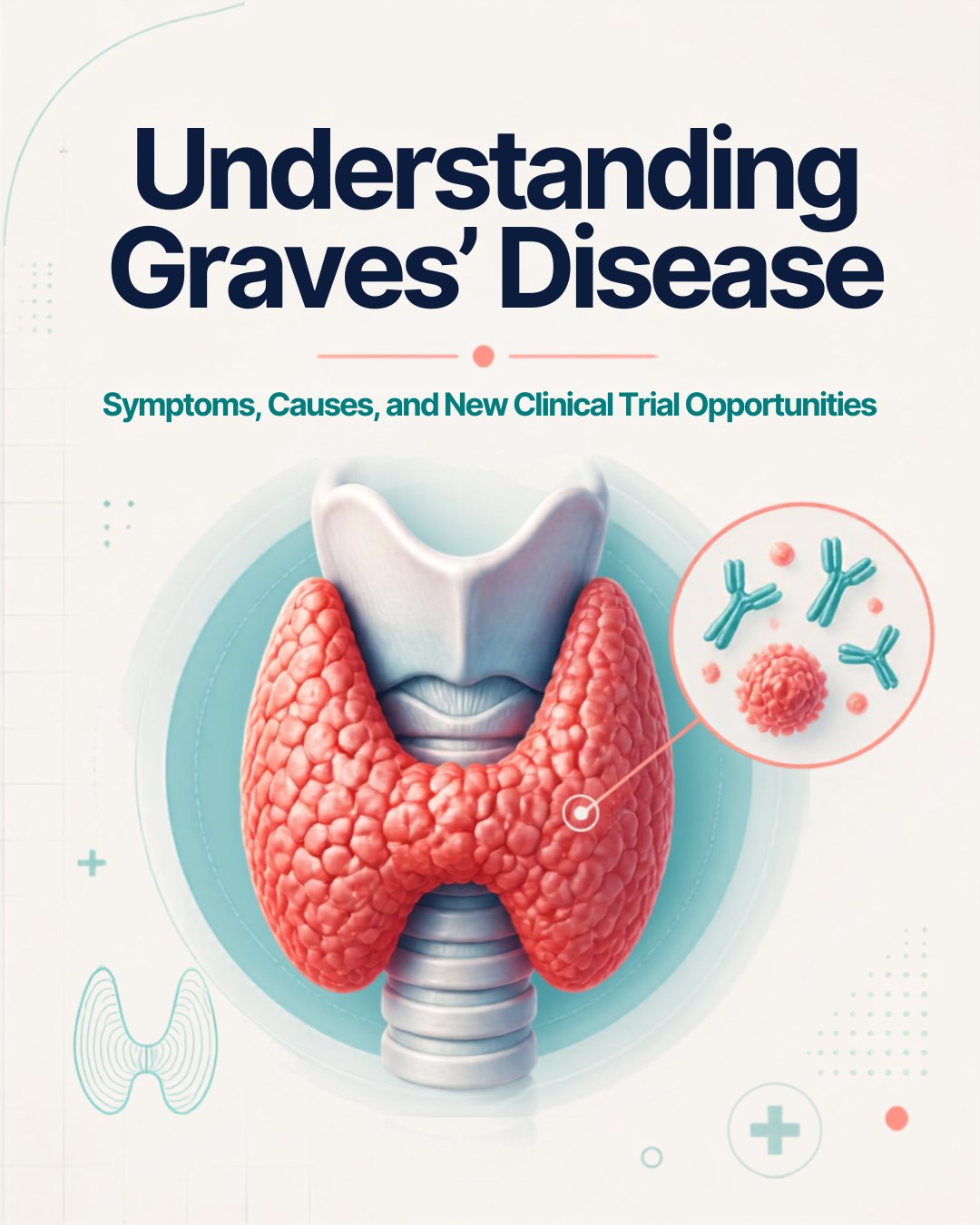
Graves’ disease is an autoimmune disorder in which the immune system produces TSHR autoantibodies that attack the thyroid gland and drive it to overproduce thyroid hormone, a state called hyperthyroidism. Standard treatment is antithyroid drugs, radioactive iodine, or surgery; the last two are permanent and usually require lifelong thyroid hormone replacement.
If you have been diagnosed with Graves’ disease, you already know how overwhelming the symptoms can be. From a racing heart and unexpected weight loss to feeling constantly exhausted yet unable to sleep, living with an overactive thyroid can deeply affect your daily life and overall well-being.
At West Orange Endocrinology in Ocoee, FL, we understand these frustrations. While there are standard medications available, they don’t work perfectly for everyone. That is why our Research Department is constantly looking for better, more effective ways to help our patients regain their health.
Here is what you need to know about Graves’ disease, and about a clinical trial we are currently conducting in the Orlando area.
What is Graves’ disease?
Graves’ disease is an autoimmune disorder that causes your thyroid gland to create too much thyroid hormone. In a healthy immune system, antibodies protect you from viruses and bacteria. But in Graves’ disease, your immune system mistakenly creates autoantibodies — specifically TSHR autoantibodies — that attack your thyroid, causing it to overwork. This condition is known as hyperthyroidism.
Common symptoms of Graves’ disease include:
- Rapid or irregular heartbeat (palpitations)
- Unexplained weight loss despite normal eating habits
- Anxiety, irritability, or tremors in the hands
- Fatigue and muscle weakness
- Sensitivity to heat and excessive sweating
- Difficulty sleeping
The need for new treatments
Currently, the standard treatments for Graves’ disease include antithyroid drugs (ATDs) such as methimazole or propylthiouracil, radioactive iodine therapy, or surgical removal of the thyroid gland.
While these options can be effective, they have limitations. Patients may rely on ATDs for years, and many still struggle to maintain normal thyroid hormone levels. Radioactive iodine and surgery, on the other hand, are permanent and anatomically invasive solutions that usually require patients to take lifelong daily thyroid hormone replacement medication.
The medical community is actively searching for new treatments that can target the root cause of the disease — the disease-causing autoantibodies — without having to permanently destroy the thyroid gland.
Clinical trials at West Orange Endocrinology
To help advance medical science and give our patients more options, our clinical research center in Ocoee is participating in a Phase 2b clinical research study.
This randomized, double-blind, placebo-controlled study is evaluating an investigational medication called IMVT-1402 for adults with Graves’ disease. IMVT-1402 is designed to work by blocking a specific receptor in the body, which helps increase the breakdown and decrease the levels of the disease-causing IgG autoantibodies in the blood. The goal of the study is to assess the safety, tolerability, and efficacy of this medication in helping patients achieve normal thyroid function without the need for traditional antithyroid drugs.
Who can participate?
You may qualify for this research study if you meet certain criteria, including:
- You are an adult between 18 and 75 years of age.
- You have a documented diagnosis of Graves’ disease.
- You are currently experiencing hyperthyroidism despite taking antithyroid drugs (ATDs) for at least 3 months.
- You have not had your thyroid surgically removed (total thyroidectomy) or been successfully treated with radioactive iodine in the past.
This is not the full eligibility criteria
- Every study has additional medical requirements that cannot be assessed from a web page.
- Whether you qualify is determined by our medical team during a formal screening visit.
- Screening does not commit you to taking part, and you may withdraw from a study at any time.
Take the next step for your thyroid health
If you are struggling to control your Graves’ disease with your current antithyroid medication, you don’t have to navigate it alone. Taking part in a clinical trial gives you access to close medical monitoring by our team, and helps pave the way for future medical breakthroughs.
Interested in learning more? Contact the Research Department at West Orange Endocrinology to see if you qualify for this study. You can reach the research team directly at (407) 480-4836.
Sources
- ClinicalTrials.gov — NCT06727604: A Study to Assess the Efficacy, Safety, and Tolerability of IMVT-1402 in Adult Participants With Graves’ Disease (Sponsor: Immunovant Sciences GmbH).
- Ross DS, et al. 2016 American Thyroid Association Guidelines for Diagnosis and Management of Hyperthyroidism and Other Causes of Thyrotoxicosis. Thyroid. 2016;26(10):1343–1421.
- National Institute of Diabetes and Digestive and Kidney Diseases — Graves’ Disease.
Medical disclaimer. This article is general education, not medical advice, and does not create a physician–patient relationship. Do not start, stop or change an antithyroid medication on the strength of anything written here — untreated hyperthyroidism can be dangerous, and so can stopping treatment abruptly. IMVT-1402 is an investigational medication: it is not approved by the FDA, and taking part in a study is not the same as receiving an approved treatment. Eligibility for any trial is determined by the study team during a formal screening visit. To speak with our team, call (407) 480-4830.
← All articles