
Diabetes Management
Beyond the Daily Spike: What Continuous Glucose Monitors Actually Teach Us About Metabolism
A CGM is a powerful teacher and a poor judge
A continuous glucose monitor (CGM) is a small sensor worn on the skin that estimates glucose every few minutes from interstitial fluid rather than from blood. Because of that, readings lag actual blood glucose by roughly 5 to 15 minutes, and the value of a CGM lies in the trend across weeks rather than in any single reading.
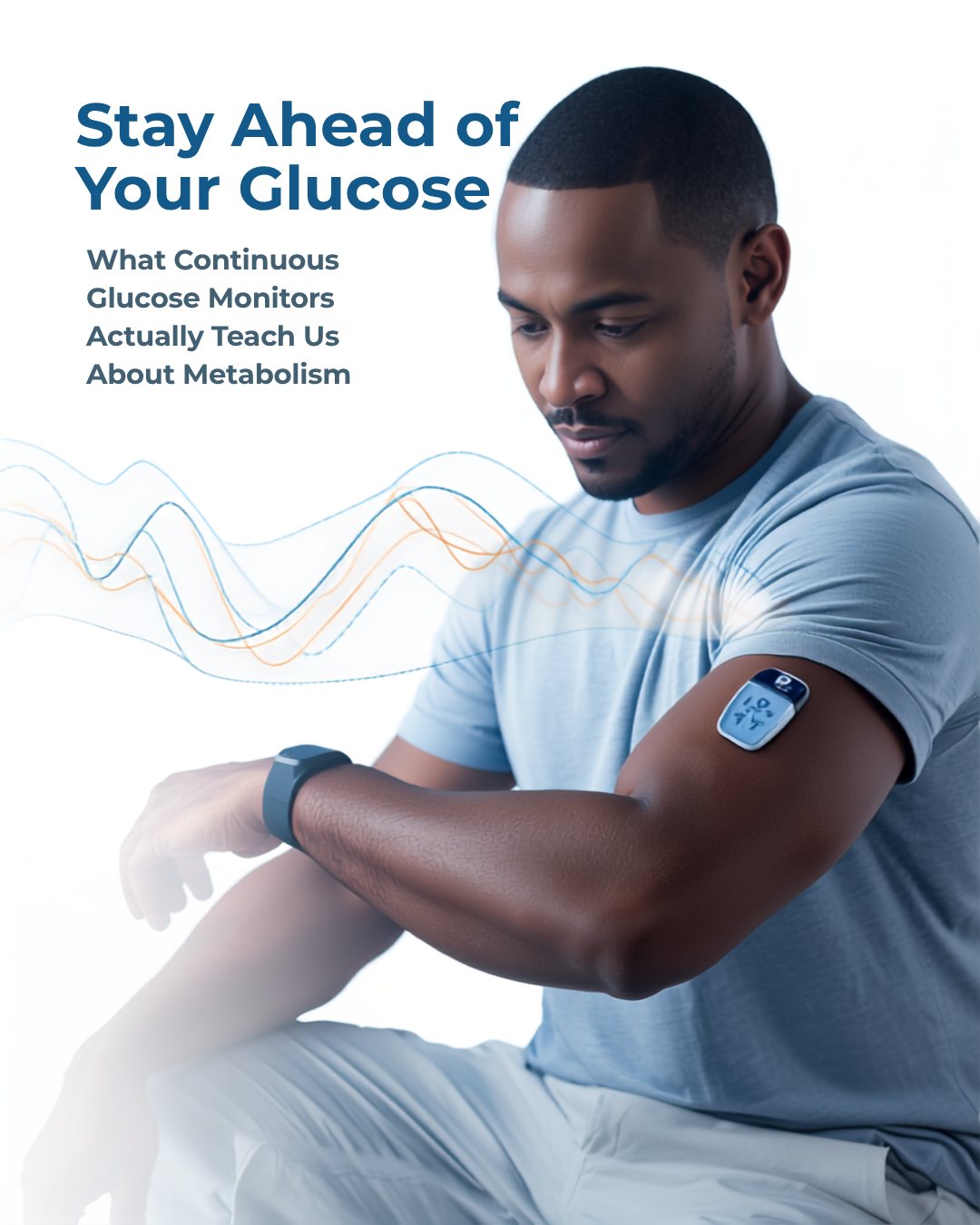
Continuous glucose monitors (CGM) are quickly moving out of diabetes clinics and into everyday athletic and wellness routines. By wearing a small sensor on the back of the arm, users are granted immediate insight into their metabolism, turning what used to be invisible biochemistry into a live transmission visible on your phone.
This immediate understanding of how your body reacts to food, stress and workouts is undeniably useful. However, treating a CGM as an absolute source of truth without proper education is a fast track to unnecessary anxiety.
What is currently out there?
The market distinguishes two categories of devices:
Two kinds of monitor
- Medical-grade CGMs — devices such as the Dexcom series or the Abbott FreeStyle Libre, built primarily for precise clinical tracking and urgent alerts.
- Consumer performance platforms — apps and subscription services that take standard sensor hardware and layer their own software over it, translating raw glucose numbers into daily “metabolic health scores” or meal ratings.
Both options give you a level of visibility that standard lab work simply cannot match, but using them effectively requires proper interpretation of the raw data.
The benefit: catching real patterns
The real benefit of a CGM does not come from staring at the number on your screen every ten minutes — it comes from spotting the trends across several weeks of collected information.
A standard fasting blood sample gives you a snapshot frozen at a single moment. A CGM provides a continuous record of how fast your glucose rises after a meal, how high it peaks, and how long levels take to return to baseline.
When you can see the trends, you stop relying on generic diet plans. Activity, meals and medication can be tailored to how a particular person responds to different carbohydrate sources, to intense exercise, and to other internal and external stressors.
The catch: interstitial lag and compression lows
Sensors are accurate, but they are not flawless. A common misconception is that these devices measure glucose directly from your blood. They do not — they measure the fluid in the surrounding tissue, known as interstitial fluid. That mechanical difference creates a few distinct irregularities worth knowing about.
The built-in delay
Because glucose moves from your bloodstream into the interstitial fluid, sensor readings naturally lag actual blood levels by roughly 5 to 15 minutes. If your sugars are rising or falling quickly, the “real time” reading on your phone is reporting where you were a few minutes ago, not where you are now.
Night-time false alarms
If you wake to a sudden, dramatic “crash” in the middle of the night, consider how you have been sleeping. Lying directly on the sensor pinches the local tissue and restricts fluid around the filament, which triggers a false drop known as a compression low. Changing position usually corrects the reading on its own.
But do not talk yourself out of a real low
- A compression low is a plausible explanation, not a diagnosis. Confirm it with a fingerstick before deciding a low reading was not real.
- If you take insulin or a sulfonylurea, or if you feel symptoms — shakiness, sweating, confusion, palpitations — treat the low first, exactly as your physician has instructed, and investigate the sensor afterwards.
Dehydration and heat
Low fluid intake, hot saunas, very hot showers and localized muscle swelling can all distort a reading for a brief window. If these are not accounted for, it is easy to mistake a temporary sensor artifact for a real metabolic problem.
Common questions
Will I have a needle in my arm for 14 to 15 days while wearing a CGM?
No. A tiny needle inside the applicator inserts the sensor beneath the skin and then retracts immediately into the device. What stays in your body for the sensor’s lifespan — typically 10 to 15 days depending on the brand — is a thin, flexible filament about the width of a human hair. Most people report a quick pinch during application and do not feel the sensor at all while wearing it.
How do I get a CGM sensor?
Most continuous glucose monitors are prescribed by a healthcare provider, and a prescription is also what allows the sensor to be billed to insurance. Since 2024 the FDA has additionally cleared several over-the-counter sensors for adults who do not use insulin, which can be bought without one. If you have type 1 or type 2 diabetes, or you are working with your provider to evaluate metabolic trends, ask whether a CGM belongs in your care plan and which route suits your situation. Once prescribed, sensors can be filled at your pharmacy or shipped through a durable medical equipment (DME) supplier.
Can a CGM sensor only be worn on the arm, or are there other approved locations?
Placement depends on the brand and model. The back of the upper arm is the most common and most widely FDA-approved site across major brands such as Dexcom and Abbott FreeStyle Libre. Some models are also approved for the abdomen or the upper buttocks, the latter primarily in children. Using an approved site for your specific device is what keeps the readings accurate and the sensor securely in place.
The takeaway: learn, do not stress
Glucose levels change constantly throughout the day. A rise after a meal is not a failure — it is normal human physiology doing its job.
CGMs are growing in popularity and can be used long term out of medical necessity, or briefly as an educational tool. Used well, the insights help build an eating pattern that fuels a particular person’s metabolism, steady out erratic glucose values, and improve overall health — and they let you make those changes without feeling glued to a screen.
Medical disclaimer. This article is general education, not medical advice, and does not create a physician–patient relationship. It is not instruction on how to interpret your own sensor data. If you take insulin or a sulfonylurea, never dismiss a low reading as a sensor artifact — treat symptoms of hypoglycemia the way your physician has instructed you to, and confirm with a fingerstick. Talk to your physician before changing your diet, your medication, or how you act on what a monitor shows you. To speak with our team, call (407) 480-4830.
← All articles