
Nutrition
A Beginner's Guide to Common Sweeteners
Where each sugar substitute came from, how sweet it really is, and what the research does and does not say
Non-nutritive sweeteners are sugar substitutes many times sweeter than table sugar, so only tiny amounts are needed and they contribute almost no calories. The options sold in the United States are saccharin, aspartame, acesulfame potassium, sucralose, and the plant-derived monk fruit and stevia extracts; sugar alcohols such as erythritol and xylitol are a separate, less sweet group. No link has been found between approved artificial sweeteners and cancer in humans.
Regular table sugar earned a bad reputation in the mid-1900s as a contributor to an increase in noncommunicable diseases, such as cardiovascular disease, hypertension, diabetes, obesity and dental caries. Sucrose — glucose and fructose — is the most common added sugar and occurs naturally in plants. Milk provides sugar as lactose, and other starches are derived from the grain family. Meat does not contain sugar unless it is processed with fillers, flavourings or breading.
It is important to establish low sugar intake at an early age to develop healthy eating habits later in life. Natural sugar in the diet is optimal; however, American food culture relies heavily on ready-to-eat, ultra-processed commercial food, which contains added sugars.
People have a desire for confections and sweets, and processed foods have added sugars to satisfy that preference. Ultra-processed foods largely rely on cane or beet sugar, high-fructose corn derivatives, or concentrated fruit sources to balance flavours, add texture, promote browning in baked goods and help with preservation. Other sugars added at the table include imitation creamers, molasses, agave, syrup, honey and table sugar.
How much added sugar is recommended
- The World Health Organization recommends that less than 10% of energy intake come from sugars added during production plus those added at the table.
- On a 2,000-calorie diet that is about 50 g of sugar — roughly 12.5 teaspoons, or a 6 oz serving of regular cola.
- The typical American diet contains about 75 g of added sugar per day, largely from sweetened beverages, soft drinks and sweetened fruit juice.
For those looking to replace sugar, there are several non-nutritive additives. These intensely sweet compounds are added in minute quantities and can help limit energy intake, assist with managing blood glucose or lipid levels, reduce inflammation, promote weight loss and support better dental health; they are also used in medicines to mask flavour. No links have been found between approved artificial sweeteners and cancer in humans.
Reviews and dietetic professionals have concluded that moderate use of non-nutritive sweeteners is a relatively safe replacement for sugar, but concerns remain about how common these products have become in the diet. Research continues into their role in certain cancers, allergies, gastrointestinal discomfort, changes to gut microflora and effects on mental health. There is even empirical evidence that the use of non-nutritive sugar substitutes contributes to obesity.
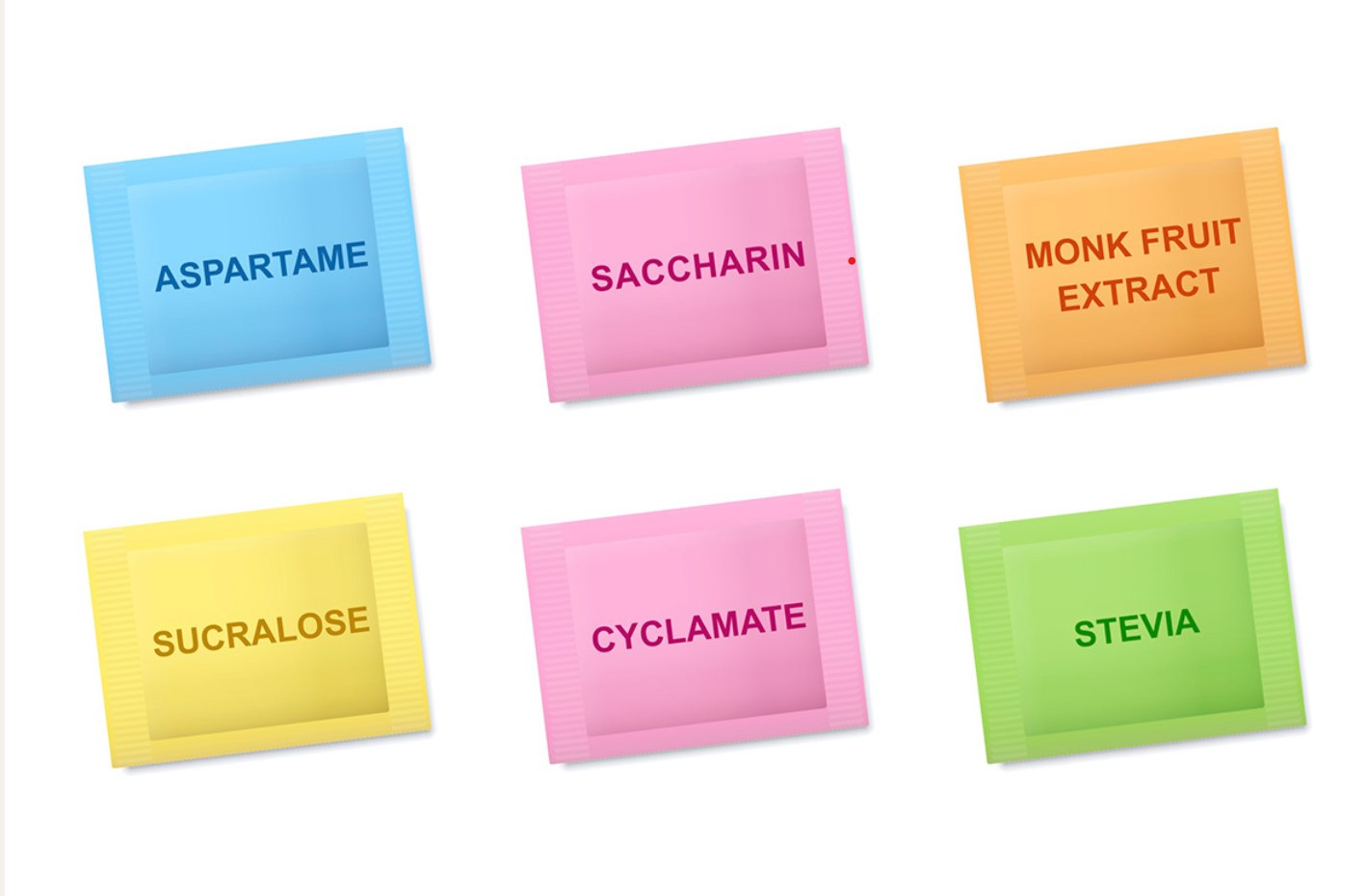
| Sweetener | Sweetness vs sugar | Where you'll see it | Worth knowing |
|---|---|---|---|
| Cyclamate | 30–50× | Not sold in the US | The first artificial sweetener, discovered 1937. Banned in the US in 1980; still sold elsewhere as Sucaryl. |
| Saccharin | 300–500× | Pink packet — Sweet'N Low, Necta Sweet | Bitter aftertaste. Inexpensive, very stable, long shelf life. |
| Aspartame | 180–200× | Blue packet — NutraSweet, Equal, Canderel | Must be avoided by people with phenylketonuria. Breaks down with heat, so it cannot be used for baking. |
| Acesulfame potassium | 200× | Sunett, Sweet One | Bitter aftertaste, so usually blended with others. Heat stable and safe for baking. |
| Sucralose | 600× | Yellow packet — Splenda | Very stable in food production. Does not promote tooth decay or spike insulin. |
| Sugar alcohols | — | Erythritol, xylitol, sorbitol and others | Fewer calories than sugar and tooth friendly, but only partly digested. Xylitol is extremely dangerous to dogs. |
| Monk fruit | — | Orange packet | Plant extract, calorie free, long shelf life. More expensive than synthetic options. |
| Stevia | — | Green packet — Truvia, Stevia in the Raw | Processed extracts are on the GRAS list; raw stevia leaf is not approved as a food additive. |
Cyclamate
Many people may not remember the cyclamate bottle once kept beside the salt and pepper shakers on the dinner table. Cyclamate, the first artificial sweetener, was discovered in 1937 by a University of Illinois graduate student developing an antipyretic — a fever reducer. Like several other artificial sweeteners, it was found when the chemist accidentally tasted the compound in the laboratory.
Cyclamate is 30 to 50 times sweeter than sugar and was approved in the early 1960s as a sugar alternative for people with diabetes. It became widely used and was often combined with saccharin to improve flavour. Rat studies in the 1960s linked the cyclamate–saccharin mixture to kidney cancer, using extremely high doses equivalent to roughly 75 times typical human consumption. Activists ultimately secured a US ban in 1980, although cyclamate remains in use in many other countries, where it is sold as Sucaryl in small pills or a liquid bottle.
Saccharin
Saccharin was discovered in 1878 by a laboratory chemist at Johns Hopkins University in Baltimore. Even though he had washed his hands, he noticed how exceptionally sweet his biscuits tasted one night; he went back to the lab and found the residue in the vials was intensely sweet. Saccharin is 300 to 500 times sweeter than table sugar and must be diluted with maltodextrins or liquids to be packaged as a table-sugar equivalent.
Saccharin — benzoic sulfamide — made a global impact on commercial foods, largely because of sugar shortages during the First World War. Since it is stable and has a long shelf life, it is often combined with other sweeteners such as cyclamate and aspartame. It lost popularity because of a bitter aftertaste and reported health concerns.
Its use was contested by activists as early as 1906, after Upton Sinclair's The Jungle, but President Theodore Roosevelt declared that anyone who thought saccharin was bad for you was an idiot. It was temporarily banned in 1970 after a study correlated bladder cancer with saccharin or cyclamate, but the FDA re-established it as generally recognised as safe for human consumption because rats metabolise saccharin differently from people. Saccharin is the pink envelope in sugar bowls, sold as Sweet'N Low, Necta Sweet and Great Value.
Aspartame
A German chemist working in 1965 on a compound to treat gastric ulcers — aspartyl-phenylalanine methyl ester — discovered its taste by licking his fingers to turn pages. Aspartame is a dipeptide containing aspartic acid and phenylalanine, an essential amino acid that can only be obtained through diet. Individuals with phenylketonuria, a rare metabolic insufficiency, cannot consume aspartame.
Aspartame is the most investigated of all the artificial substitutes. It was first approved by the FDA in 1974 and re-approved in 1981 after a brief withdrawal, once the stability of phenylalanine and its possible effects on human health had been established. It is estimated that an adult could consume up to 75 packets of aspartame, or 21 diet sodas a day, without unwanted side effects.
Its calorie value is the same as sugar, but only a minute amount is needed for flavour. It is 180 to 200 times sweeter than sugar and, like other concentrated sweeteners, is combined with maltodextrins, diluted or enclosed in lipid particles for table use. It does not have a stable shelf life, breaks down at neutral or high pH, and cannot be used for baking. Aspartame is synergistic with acesulfame potassium or saccharin, which enhances flavour and improves stability in canned soda. It tastes better than saccharin and is mostly used in diet sodas, fruit juices, candies and gum. NutraSweet, Equal and Canderel are the trade names, packaged in blue packets. Neotame is a derivative of aspartame that is heat stable and can be used in baking.
Acesulfame potassium
Acesulfame potassium — Acesulfame-K or Ace-K — was another sweetener discovered in the lab by mistake, in 1967. The crystallised potassium salt was tested and synthetically designed for human consumption, and by 1988 the FDA had approved it for table use under the trade names Sunett and Sweet One.
It is 200 times sweeter than sugar with a bitter aftertaste, so it is often combined with sucralose or aspartame in sodas, protein drinks, liquid or chewable medicines, gums and candies. The salt is stable across many pH levels and can be safely used in baked products. It is excreted by the kidneys and is so common in the American diet that it has been used to detect urine contamination in public pools.
Sucralose
In 1975, scientists were exploring the properties of sucrose by adding a sulfuryl chloride molecule. One chemist asked another to “test” the new compound, and he thought the request was to “taste” it. Sucralose is about 600 times sweeter than sucrose — it is a sucrose molecule with three hydroxy groups replaced by chlorine.
The product is very stable in food production and does not promote tooth decay or cause spikes in insulin levels. The commercial success of sucralose-based products stems from how favourably it compares with other low-calorie sweeteners on taste, stability and safety. It is marketed as Splenda in a yellow packet.
Sugar alcohols
Sugar alcohols occur naturally in some fruits and vegetables, but the commercially used products are hydrogenated sugar molecules: erythritol, xylitol, sorbitol, maltitol, mannitol, isomalt and lactitol. They contain no ethanol, so despite the name they are not intoxicating. They have fewer calories than sucrose, with the popular erythritol at about 0.6 calories per serving.
Sugar alcohols are tooth friendly; xylitol and sorbitol are often used in sugar-free gums, toothpaste, liquid medicines and smokeless tobacco products. They are considered safe and do not increase insulin levels, but they are only partially digested and can cause bloating, gas, abdominal cramping or diarrhoea. Erythritol is available in bulk and is often combined with the other sweetener packets you find at the coffee bar.
Monk fruit and stevia
Two plant-source products are available as non-caloric sweeteners. Monk fruit — Luo Han Guo — grows in very specific and rare climates in southeast Asia and, as the name suggests, Buddhist monks used the fresh gourd and promoted its homeopathic use in tea. Monk fruit turns rancid very quickly once harvested, which made it unappealing to cultivate for indigenous populations.
Stevia has been used for centuries by the Guaraní peoples of South America, who called it ka'a he'ê, or “sweet herb”. The genus was named after Petrus Jacobus Stevus (1500–1556), a professor of botany at the University of Valencia. In America, extracts of the processed plant are included on the GRAS list, but natural stevia leaf is not FDA approved as a food additive. In August 2019, updated in May 2025, the US FDA placed an import alert on stevia leaves and crude extracts — which do not have GRAS status — and on foods or dietary supplements containing them, over concerns about safety and potential toxicity.
Monk fruit and commercial stevia do not increase insulin response, are considered calorie free, and are regarded as safe for children, pregnant women and people with diabetes. They have a long shelf life when bought in bulk and can be used in cooking, baking or liquids. Both are more expensive than other artificial sweeteners. Monk fruit comes in orange packets; stevia comes in green ones, sold as Stevia in the Raw and Truvia.
Three things worth remembering
- People with phenylketonuria (PKU) cannot consume aspartame, because they cannot properly metabolise phenylalanine.
- Sugar alcohols are only partially digested, so they can cause bloating, gas, cramping or diarrhoea — start small if you are new to them.
- Xylitol is extremely dangerous to dogs. It triggers a rapid insulin release that leads to life-threatening hypoglycaemia, so keep sugar-free gum and baked goods well out of reach.
Sources
- Harvard Health Publishing — The sweet danger of sugar.
- Centers for Disease Control and Prevention — Added Sugars: Data and Research.
- World Health Organization — Sugars factsheet (WHO Regional Office for Europe).
- Pearlman M, Obert J, Casey L. The Association Between Artificial Sweeteners and Obesity. Curr Gastroenterol Rep. 2017;19(12):64.
- Blasche S, Periwal V, Beristain Covarrubias N, et al. Common xenobiotics modulate gut microbial responses to low-calorie sweeteners in vitro. Mol Syst Biol. 2026;22:1453–1473.
- Oral nicotine pouches: rising popularity of a new class of tobacco products among youth. Public Health. 2026;258:106412.
- International Food Information Council — Everything You Need to Know About Stevia Sweeteners.
Medical disclaimer. This article is general nutrition education, not medical advice, and does not create a dietitian–patient or physician–patient relationship. The intake figures quoted are population-level guidance, not personal targets — if you have diabetes, kidney disease or phenylketonuria, or you are pregnant, your own limits may be very different. People with phenylketonuria must avoid aspartame. Talk to your physician or dietitian before making changes to your diet. To speak with our team, call (407) 480-4830.
← All articles